Advantage Point
How AI monitoring uncovered a pattern that manual oversight had missed

8:00 AM
clock-in reported
8:14 AM
actual arrival discovered
The Discovery
When a Caregiver Was Late, AI Was Watching
It started as a routine late arrival alert. A caregiver was supposed to arrive at 8:00 AM but hadn't clocked in. Zingage's AI—which the Advantage Point team calls 'Radhi'—immediately went to work.
Ashley, a Care Coordinator at Advantage Point, walked through what happened:
'Caregiver was late. We were talking to Radhi at 8 o'clock—she never arrived. Radhi got onto it, left three messages, then called the client, which I liked, to say: is everything okay?'
The client confirmed: 'She's not here. But I'm safe.'
That proactive client check—ensuring safety first—is exactly what good care coordination looks like. But what came next revealed something unexpected.
"It was fantastic. We've completely uncovered something we didn't know was happening."
— Ashley, Care Coordinator
Uncovering a Deeper Issue
By 8:32 AM, with still no caregiver contact, Radhi messaged the team: 'We still don't know. We're going to send in a replacement.' The AI had already begun searching for backup coverage.
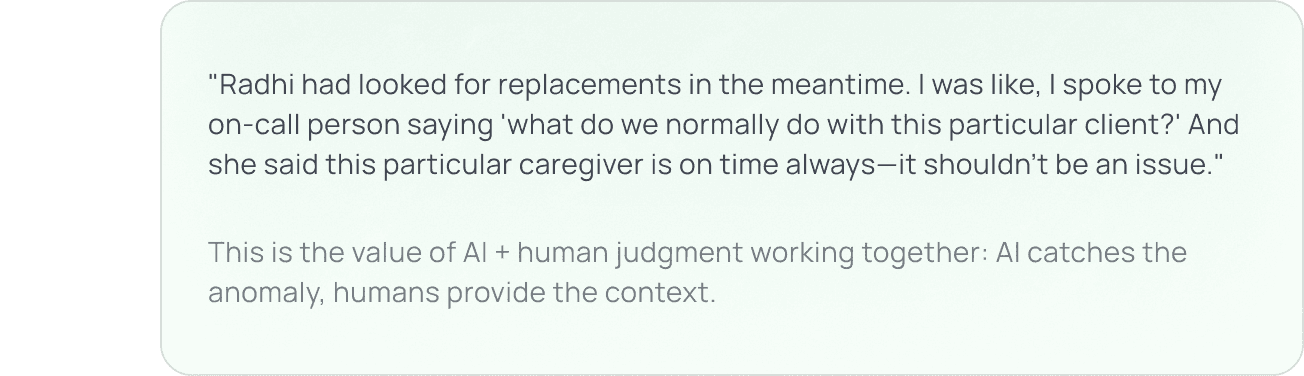
Ashley consulted with her on-call person: 'What do we normally do with this particular client?' The answer: 'This particular caregiver is on time always—it shouldn't be an issue.'
So they held off on the replacement. Shortly after, the caregiver arrived—at 8:14 AM, not 8:00 AM.
Then came the revealing moment.
'Here's what was quite interesting,' Ashley explains. 'The caregiver said she texted the agency her clock-in time, which she then did because she obviously saw all these panicked missed calls. And she said, "Please clock me in at 8:00."'
The caregiver had requested to be clocked in at 8:00 AM when she actually arrived at 8:14 AM.
'A blatant lie, because she wasn't there,' Ashley notes. 'Now I don't know how long this has been going on for. We don't know.'
Following the Thread
The discovery prompted immediate action:
'We're actually calling the client now just to shoot the breeze—to kind of go, is this normal? Is she normally late? She's clocked in at 8:00 and then I want to see if she actually clocks out at her 12-hour shift at 8 PM or if she makes it up at the end.'
What started as a routine late arrival alert had uncovered a potential pattern of time discrepancies that manual oversight had missed. Without AI monitoring every clock-in in real-time and proactively reaching out when something seemed off, this pattern might have continued indefinitely—affecting compliance, billing accuracy, and client care.
Compliance at Scale
For agencies managing hundreds or thousands of shifts per week, it's impossible for humans to monitor every clock-in in real-time. Patterns slip through. Small discrepancies accumulate.
Zingage's proactive monitoring means:
Every late arrival is flagged immediately—not discovered during a weekly audit
Clients are contacted to confirm safety—not left wondering where their caregiver is
Patterns emerge faster—one incident can reveal a systemic issue
Documentation is automatic—every call, every message, every timestamp is logged

Industry
Home Care
Location
United States
Use Case
EVV & Compliance
Key Learnings
Proactive beats reactive
AI caught the issue in real-time, not during a compliance audit
Safety first
The AI's first action was confirming the client was safe.
Patterns surface
What looked like one late arrival revealed a potential ongoing issue.